

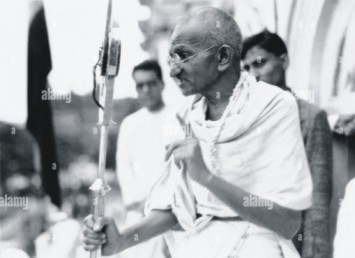
Here is an exploration of Gandhi’s idea of Hinduism through six excerpts which carry his thoughts on religious conversion. The excerpts, dating from 1924 to 1937, have been taken from Young India and Harijan— his weekly publications. First one- Why I am Hindu… (Editor)
An American friend who subscribes herself as a lifelong friend of India writes: As Hinduism is one of the prominent religions of the East, and as you have made a study of Christianity and Hinduism, and on the basis of that study have announced that you are a Hindu, I beg leave to ask of you if you will do me the favour to give me your reasons for that choice. Hindus and Christians alike realize that man’s chief need is to know God and to worship Him in spirit and in truth. Believing that Christ was a revelation of God, Christians of America have sent to India thousands of their sons and daughters to tell the people of India about Christ. Will you in return kindly give us your interpretation of Hinduism and make a comparison of Hinduism with the teachings of Christ? I will be deeply grateful for this favour.
I have ventured at several missionary meetings to tell English and American missionaries that if they could have refrained from ‘telling’ India about Christ and had merely lived the life enjoined upon them by the Sermon on the Mount, India instead of suspecting them would have appreciated their living in the midst of her children and directly profited by their presence. Holding this view, I can ‘tell’ American friends nothing about Hinduism by way of ‘return’. I do not believe in people telling others of their faith, especially with a view to conversion. Faith does not admit of telling. It has to be lived and then it becomes self-propagating.
Nor do I consider myself fit to interpret Hinduism except through my own life. And if I may not interpret Hinduism through my written word, I may not compare it with Christianity. The only thing it is possible for me therefore to do is to say as briefly as I can, why I am a Hindu.
Believing as I do in the influence of heredity, being born in a Hindu family, I have remained a Hindu. I should reject it, if I found it inconsistent with my moral sense or my spiritual growth. On examination I have found it to be the most tolerant of all religions known to me. Its freedom from dogma makes a forcible appeal to me inasmuch as it gives the votary the largest scope for self-expression. Not being an exclusive religion, it enables the followers of that faith not merely to respect all the other religions, but it also enables them to admire and assimilate whatever may be good in the other faiths. Non-violence is common to all religions, but it has found the highest expression and application in Hinduism. (I do not regard Jainism or Buddhism as separate from Hinduism.) Hinduism believes in the oneness not of merely all human life but in the oneness of all that lives. Its worship of the cow is, in my opinion, its unique contribution to the evolution of humanitarianism. It is a practical application of the belief in the oneness and, therefore, sacredness, of all life. The great belief in transmigration is a direct consequence of that belief. Finally the discovery of the law of varnashrama is a magnificent result of the ceaseless search for truth. I must not burden this article with definitions of the essentials sketched here, except to say that the present ideas of cow-worship and varnashrama are a caricature of what in my opinion the originals are. In this all too brief a sketch I have mentioned what occurs to me to be the outstanding features of Hinduism that keep me in its fold.
Young India, 20th October 1927.
